Checkout using your account
Checkout as a new customer
Creating an account has many benefits:
- See order and shipping status
- Track order history
- Check out faster
QuEChERS Pesticide

QuEChERS Pesticide from LCTech offers an efficient sample preparation system for pesticide analysis in food and feed. The method replaces a purification step using non-dispersive push-through columns and enables the reliable processing of a wide variety of different matrices. Compared to conventional dispersive QuEChERS purification, there is no need for shaking or centrifugation, which significantly simplifies and speeds up the workflow. At the same time, the non-dispersive technique ensures improved purification performance with high recovery rates and excellent reproducibility. The reduced matrix interference also supports reliable LC-MS or GC-MS analysis. The different product versions (I, II and III) are each tailored to specific matrix types and allow for a targeted selection to meet the respective requirements of residue analysis.
Technical Data
Areas of application
Pesticide I: Fruit and vegetables
Pesticide II: Tea, Spices and Hops
Pesticide III: Matrices with a high fat content (>10%)
QuEChERS à la LCTech – What does that mean?
The QuEChERS method (“Quick, Easy, Cheap, Effective, Rugged, Safe”) is an established technique for the sample preparation and extraction of multiple pesticide residues from fruit, vegetables, cereals and processed foods. The method is based on dispersive solid-phase extraction (d-SPE) using acetonitrile as the extractant. To this end, the sample to be analysed is ground, homogenised and mixed with acetonitrile and an internal standard. After thorough mixing, NaCl, MgSO₄ and buffer salts are added to enable efficient phase separation between the organic and aqueous phases. The sample is then stirred again and centrifuged so that the organic phase containing the analytes can be separated.
In the subsequent clean-up step, further purification is usually carried out using dispersive solid-phase extraction. MgSO₄ and suitable sorbents are used for this purpose to specifically remove unwanted co-extracts and matrix components. After remixing and subsequent centrifugation, a purified extract is obtained, which can then be analysed by LC-MS or GC-MS. With LCTech’s QuEChERS Pesticide kits, this purification step is significantly simplified. The resulting acetonitrile extract can be purified using an SPE column adapted to the respective matrix and is then immediately ready for injection for LC-MS analysis. For GC-MS analysis, it should be noted that a corresponding solvent change is required. The non-dispersive method significantly reduces the workload, as neither additional shaking nor centrifugation steps are required. At the same time, improved clean-up performance is achieved, which is reflected in high recovery rates and easy reproducibility. Furthermore, the reduced matrix burden leads to lower maintenance and cleaning requirements for the LC-MS and GC-MS systems used, thereby minimising system downtime and significantly increasing sample throughput.

Downloads
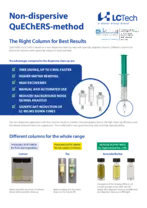 LCTech QuEChERS Pesticide - Pesticide Columns Infosheet
The right column for you - we will be happy to support you individually
Competent consultants are always at your side. Write a message to our consultants, we will get back to you and give you individual support.
You will find:
 Application support
 Availability and delivery times
 Price information with individual conditions
 Certificates of analysis, MSDS, data sheets