Checkout using your account
Checkout as a new customer
Creating an account has many benefits:
- See order and shipping status
- Track order history
- Check out faster
Hydrophobic Interaction Chromatography (HIC)
Hydrophobic interaction chromatography (HIC) is a specialised method used to separate biomolecules by exploiting their hydrophobic properties. This method plays a central role in the purification and analysis of proteins, peptides and other macromolecules, particularly when it is important to preserve the native structure and function of the molecules.
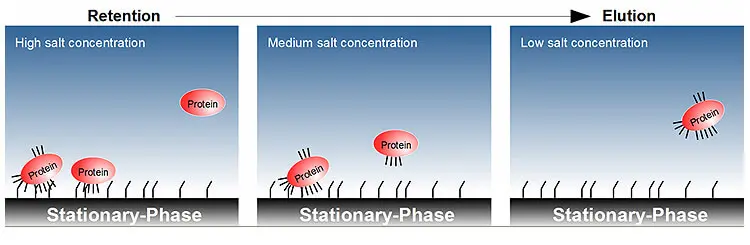
The separation is based on the interactions between the hydrophobic regions of the proteins and a weakly hydrophobic stationary phase. The analytes are therefore separated according to their degree of surface polarity. Proteins with high surface hydrophobicity are retained more strongly by the stationary phase than those whose hydrophobic regions are predominantly located within the protein. These interactions between the protein and the stationary phase are further significantly enhanced by the addition of salts to a buffered mobile phase, as the solubility of the proteins is reduced by the presence of the salts, thereby increasing the protein’s hydrophobic interactions with the stationary phase. The proteins are eluted from the column via a descending salt gradient. The mobile phase is purely aqueous and free from organic solvents, as these can lead to denaturation of the proteins being analysed.
Here you will find an overview of manufacturers and HILC-HPLC columns. We would be happy to assist you in selecting the right column for your analytical requirements!

Technical Data
How do I choose the right HIC pillar?
When selecting the appropriate HIC column, the key considerations are usually the base material, porosity and modification.
Polymers such as polymethacrylate are frequently used as the base material, although silica materials are also available. As organic solvents are not usually used in HIC, polymers are preferred due to their higher pH stability. However, if organic solvents are used, a silica column may also be selected, as the material does not swell.
With regard to porosity, a choice can be made between porous and non-porous materials. As HIC is predominantly used for proteins, large pores are usually employed. A porous material has a larger surface area and therefore a higher binding capacity. However, this results in slightly longer retention times (or run times). Non-porous materials have a significantly smaller surface area and therefore a lower binding capacity. As a result, separations are quite rapid.
- slow separation and high binding capacity → porous (e.g. preparative separation, large amount of matrix)
- Fast separation and low binding capacity → non-porous (e.g. rapid elution required, analytical quantities only)
HIC phases have a slightly hydrophobic character. Butyl or phenyl ligands are usually used for this purpose, although other modifications such as C2, C3 or C6 are also available. The most commonly used ligand is the C4 (butyl) group. Phenyl can be used as an alternative with a less hydrophobic character. As a rough guide:
- less hydrophobic analytes → ligand with high hydrophobicity
- highly hydrophobic analytes → ligands with lower hydrophobicity
Manufacturer and columns of hydrophobic interaction chromatography
Shodex™
| Name | Functional Group | Particle Size | Pore Size | Column Size |
| HIC PH-814 | Phenyl | 10 µm | 2000 Å | 8.0 x 75 mm |
Base material: Polyhydroxymethacrylate
Tosoh Bioscience™
| Name | Functional Group | Particle Size | Pore Size | Column Size |
| TSKgel Ether 5-PW | Polyether | 10 µm | 1000 Å | 5.0 x 50 mm[1] |
| TSKgel Phenyl 5-PW | Phenyl | 10 µm | 1000 Å | 5.0 x 50 mm[1] |
| TSKgel BioAssist Phenyl | Phenyl | 10 µm | 1000 Å | 7.8 x 50 mm[4] |
| TSKgel Butyl-NPR | Butyl | 2.5 µm | Non-porous | 4.6 x 35 mm[2] |
Base material: polymethacrylates; [1] glass columns; [2] stainless steel columns; [3] particle size 13 µm; [4] PEEK column
Thermo Scientific™
| Name | Functional Group | Particle Size | Pore Size | Column Size |
| MAbPac HIC-10[1] | Proprietary polyamide | 5 µm | 1000 Å | 4.6 x 100 mm |
| MAbPac HIC-20[1] | Proprietary alkylamide | 5 µm | 1000 Å | 4.6 x 100 mm |
| MAbPac HIC-Butyl[2] | Butyl | 5 µm | Non-porous | 4.6 x 100 mm |
| ProPac HIC-10[1] | Proprietary alkylamide | 5 µm | 300 Å | 7.8 x 75 mm |
[ 1] Base material: Silica gel; [2] Base material: Hydrophilic polymer
The right column for you - we will be happy to support you individually
Competent consultants are always at your side. Write a message to our consultants, we will get back to you and give you individual support.
You will find:
 Application support
 Availability and delivery times
 Price information with individual conditions
 Certificates of analysis, MSDS, data sheets