Checkout using your account
Checkout as a new customer
Creating an account has many benefits:
- See order and shipping status
- Track order history
- Check out faster
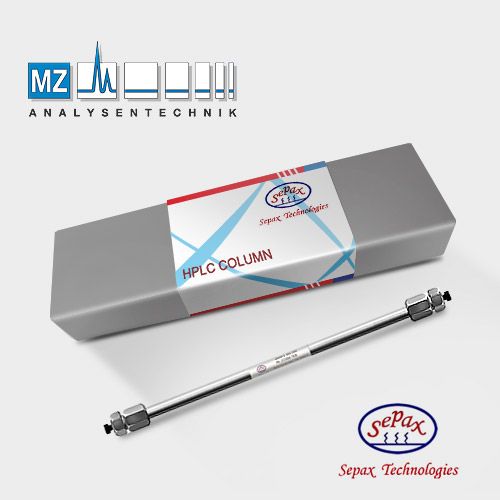
Sepax Bio-C18 5µm 300Å 250x4.6mm HPLC-Column

Questions, MSDS, CoA?
Do you have any questions? Give us a call or send us an email!

Product Description
The Bio-C18 HPLC column 250x4.6mm, 5µm, bears octadecyl groups, also referred to as ODS, RP-18 or C18, and is available in two pore sizes, namely 200 and 300 Å. Separation is effected by hydrophobic interaction, and the long chain binds most strongly within the series.This results in the highest retention, which is important for peptide maps and for polar analytes. The 200 Å version provides the larger separation surface and more retention, whereas the 300 Å version accommodates larger molecules.The particles consist of spherical, low-metal silica. The chains are monomer-bonded and the remaining free silanol groups are covered by endcapping.This keeps secondary interactions low, which would otherwise cause tailing for basic analytes. The pH range extends from 2 to 9 with an optimum between 3 and 7.5.Eluents are mixtures of water with acetonitrile or methanol, also with buffer, whereby the water proportion should not exceed 95 percent.Target analytes are peptides, peptide maps, small proteins and amino acids. As an application example, the separation of peptides from an enzymatic digest is documented.
Features and Benefits
- Reversed phase columns for peptides and proteins
- Wide-pore sizes of 200 and 300 Å
- Butyl, octyl, and octadecyl
- Each chain is monomerically bonded
- Residual silanols are end-capped
- Low-metal silica
Additional Notes
Bio is the reverse-phase series for biomolecules and differs from the company’s other silica series in terms of pore size. While GP, HP, and BR range from 60 to 120 Å and are thus designed for small molecules, Bio operates at 200 and 300 Å. The reason is simple: a peptide or small protein cannot even enter a 120 Å pore system and therefore only comes into contact with a fraction of the surface. With wider pores, however, the entire surface is accessible, which improves peak shape, recovery, and loading capacity. The series includes three chain lengths - namely butyl, octyl, and octadecyl - and a shorter chain binds more weakly and elutes large proteins more gently. The various modifications are monomer-bound and end-capped. The number in parentheses in the Bio-C8(2) designation indicates a second variant with narrower pores.
Legal Information
Bio is a product of Sepax Technologies, Inc., Newark, Delaware, USA. Sepax uses the name “Sepax” as a trademark. The product and phase names mentioned are part of the manufacturer's chromatography portfolio.
Product Specification
| Brand | Bio |
|---|---|
| Product Type | HPLC Column |
| Length | 250 mm |
| Internal Diameter | 4.6 mm |
| Particle Size | 5 µm |
| Chemistry | C18 (RP-18, ODS, Octadecyl) |
| Chemistry Producers Term | C18 |
| Pore Size | 300 Å |
| USP Class | L1 |
| Carbon Load | 7.0 % |
| Bet Surface Area [m2/g] | 105.0 |
| Endcapping | endcapped |
| Country of Origin | United States of America (USA) |
| Column Type | Analytical Column |
| Hardware Material | Stainless Steel |
| Hardware Type | Ready-to-use Column |
| pH Minimum | 3.0 |
| pH Maximum | 7.5 |
| Mode of Separation | Reversed Phase Chromatography (RP) |
| Technology | HPLC |
| Matrix | Silica |
| Particle Morphology | spherical, fully porous |
